The dog toy that works as a front-desk giveaway at a veterinary clinic is rarely the one a boarding kennel should hand out, and neither is what a pet brand wants tucked into a retail bundle. On a catalog page they all sit in the same category, but the use case quietly changes almost every specification that matters: unit cost, durability, imprint size, and how many you have to buy at once. This guide walks through the four business situations behind most custom dog toy orders and what each one should lock down before requesting a quote.
Start with how the toy gets handed out
The handoff context drives the whole decision. A toy that lives in a bowl on a reception counter needs to be cheap, small, and light to store, because you will give away hundreds and reorder often. A toy handed out at a booth or adoption event needs to catch the eye across a crowded room and carry your logo clearly. A toy tucked into a retail bundle has to feel worth the shelf price it rides on. And a toy going home with a newly adopted dog has to be safe and durable on a tight budget. Decide the handoff first, and most of the other specifications fall into place on their own.
The four use cases and what each one should prioritize
Vet clinics and groomers are running counter giveaways. The winning pick is usually a simple ball, tennis ball, or small squeaker at the low end of the price range, because volume and reorder frequency matter more than novelty. Imprint area on these small toys is genuinely tiny, often around half an inch by an inch and a quarter, so a clean one-color mark of your name or paw logo reads far better than a detailed full-color design that will only blur.
Shelters and rescues need budget durability. The toy is going into a shared or high-stress environment, so rope and nylon styles that tolerate rough handling tend to outlast plush. Safety deserves real attention here: pet toys in the United States are not held to the same federally mandated safety testing as children’s toys, so the burden is on the buyer to ask about non-toxic materials, secure seams, and choke-sized parts rather than assuming a standard covers it.
Boarding, daycare, and training operations are buying for genuine chewers and should expect wear. Rubber and nylon chew styles hold up best, and the smart move is to treat these as consumable, buying in enough volume that replacing a chewed toy costs pennies rather than planning for any single toy to last forever. Match the toy’s stated chew rating to the strongest dogs you actually board, not the average.
Pet brands and retail sellers are the one group that should spend up. Here the toy represents the brand on a shelf next to competitors, so consistent color, a premium material, retail-ready packaging, and sometimes a fully custom mold are worth the added cost and time. This is also the only use case where the longest production paths usually make sense.
Quantities and what you will actually pay
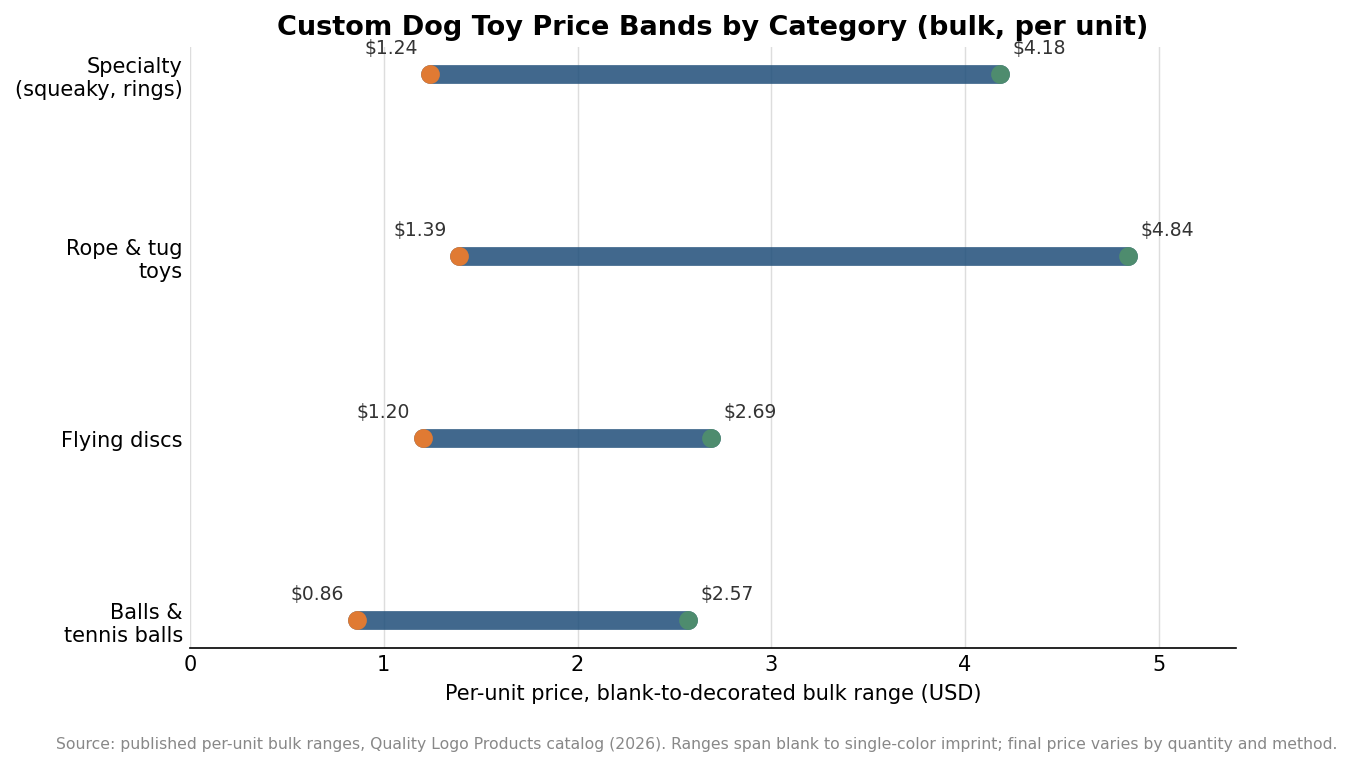
Minimum order quantities for decorated dog toys generally start somewhere between about 100 and 144 units, depending on the supplier and the decoration method, with lower minimums on simple imprints and higher ones on anything molded. Per-unit pricing tracks the category more than anything else. Plain balls and tennis balls sit at the bottom, roughly under a dollar to around two and a half dollars each in bulk, while rope, tug, and specialty squeaky toys climb into the three to five dollar range. Those figures are indicative catalog ranges rather than a quote for your exact art, and they compress as you move from a starter run into the several-hundred and thousand-unit brackets, so if a giveaway program is ongoing it is usually worth pricing the next tier up before committing to the minimum.
Match the decoration method to the toy
How your logo goes on depends on the surface. Screen and pad printing suit smooth rubber and vinyl, embroidery and woven labels belong on plush and fabric, and embossing or debossing works on molded rubber where a printed mark would rub off. Heat transfer covers full-color art on the right substrate. Two constraints matter most when you specify: the imprint area is small, ranging from that half-inch mark on tiny toys up to roughly three and three-quarter inches across on larger items, and whatever you print has to survive a mouth. Placing the logo on a handle, panel, or end that sees less direct chewing will keep it legible far longer than centering it on the part the dog actually bites.
Lead time is the number that derails events
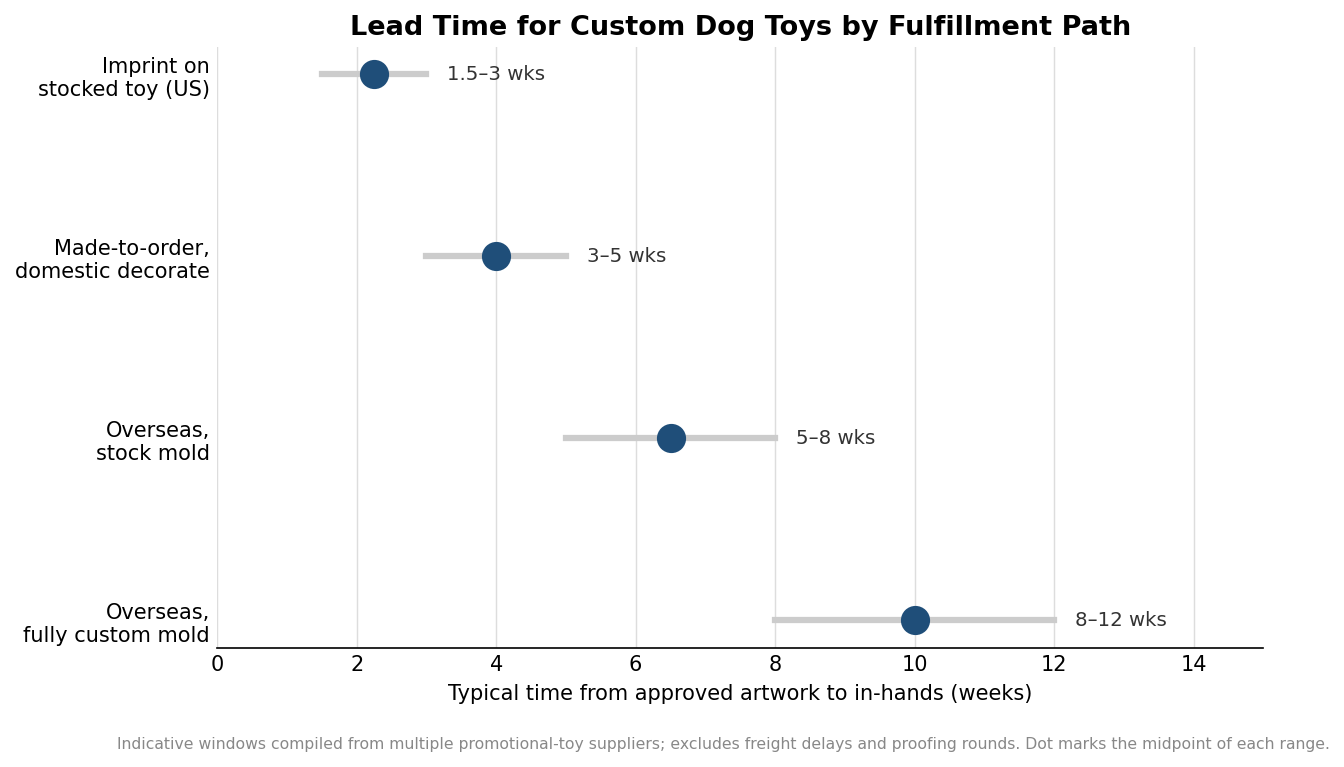
The single most common ordering mistake is backing into an event date. Imprinting a logo onto a toy a supplier already stocks domestically is the fast path, often around one and a half to three weeks once artwork is approved. A domestic made-to-order decoration runs closer to three to five weeks, an overseas run on an existing mold roughly five to eight, and a fully custom molded toy commonly eight to twelve weeks or more before freight. Those windows exclude the proofing rounds and any shipping delays, so plan backward from the in-hands date you actually need, add a buffer for a revised proof, and confirm the real timeline in writing before you count on toys arriving for a specific weekend.
Putting it together
Before you request a quote, settle five things in order: the use case and how the toy will be handed out, the per-unit cost you can live with, the quantity that both clears the minimum and matches your program, the toy type and material suited to the dogs receiving it, and the decoration method with print-ready art already prepared. Bring those to a supplier and the conversation turns into a single accurate quote instead of three rounds of back-and-forth, and the toys that show up will fit the job you bought them for.