The material a custom dog toy is molded or sewn from decides almost everything that matters after the logo goes on: how long it survives a determined chewer, whether it is safe in the mouth of the dog it reaches, how easily it washes, and what it costs you per unit. Two toys can carry the same imprint and look nearly identical in a catalog photo while behaving completely differently in a living room. This guide walks through the materials you will actually be quoted on, what each one is good and bad at, and how the choice moves your price.
Natural rubber: the default for dogs that actually chew
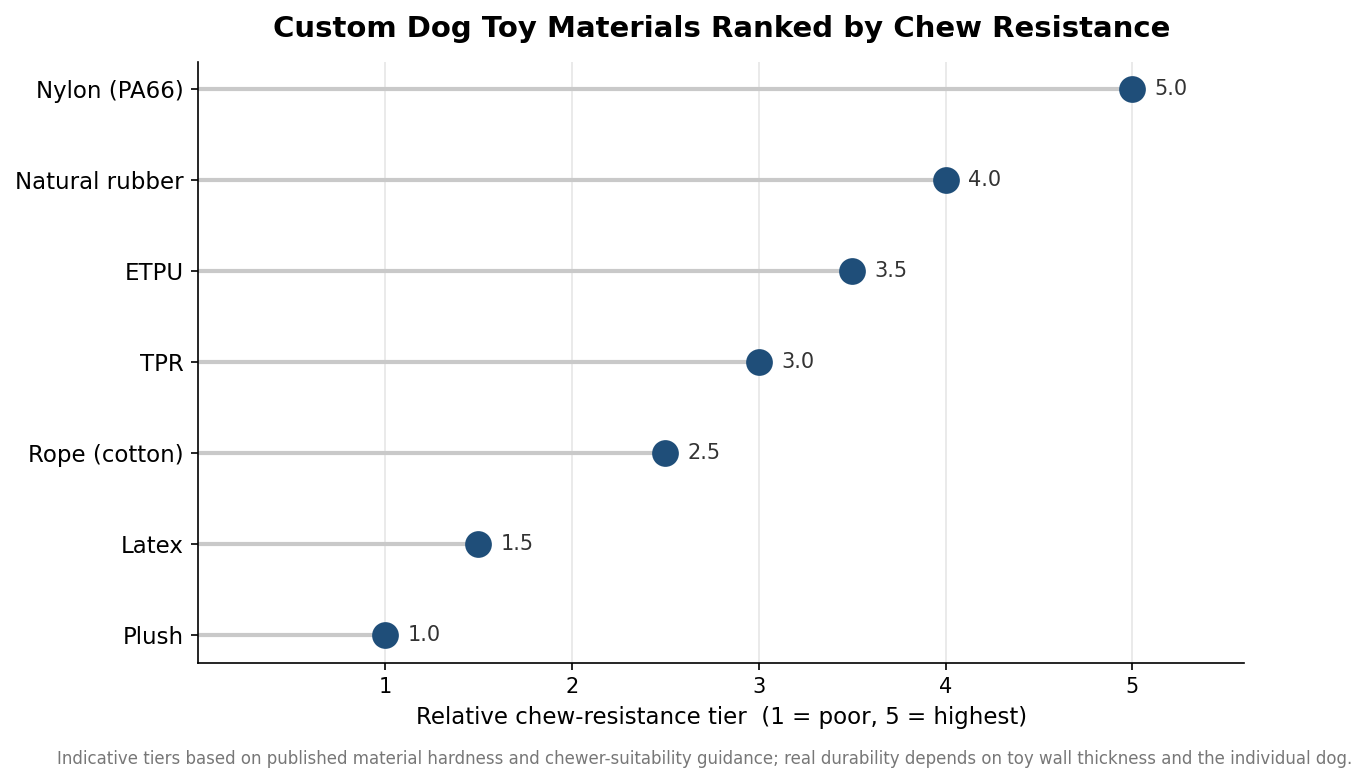
Natural rubber is the workhorse of the custom chew-toy world for good reason. It is flexible, non-toxic, and forgiving on teeth and gums, which means a dog can work it hard without the sharp-fracture risk that harder plastics carry. Molded rubber also holds a debossed or recessed logo well, and hollow versions double as treat dispensers, which keeps a branded toy in front of the dog longer. It suits medium to heavy chewers and cleans up easily with soap and water. The tradeoff is weight and cost: solid rubber uses more material than a thin synthetic shell, so a rubber toy of any real size sits toward the upper half of the price range. If your giveaway is going to dogs whose owners describe them as “destroyers,” rubber is usually the safest specification that still survives.
Nylon and the hardness tradeoff
Nylon is the hardest material on most pet-toy line sheets, and that hardness cuts both ways. The PA66 grade is meaningfully stronger than standard PA6 and can stand up to aggressive chewing that would shred anything softer. But hard is not the same as safe. A material rigid enough to resist an aggressive chewer is also rigid enough to chip a tooth, and when pieces do break off they can splinter rather than deform. Reputable suppliers position nylon for genuinely powerful chewers under supervision, not for dogs with soft mouths or for unsupervised handout scenarios. If you are ordering toys to give away at an event where you have no idea what breed picks one up, nylon is a riskier default than rubber, even though it wins a pure durability contest.
That durability contest is worth seeing laid out, because the ranking is fairly stable across suppliers even though the exact wording changes.
TPR, ETPU, and latex: the softer synthetics
Between hard nylon and soft plush sits a family of engineered rubbers that most branded squeaky toys, balls, and flyers are made from. TPR, or thermoplastic rubber, is non-toxic, pleasantly flexible, and inexpensive to mold, which is why so much light-to-moderate promotional product is made from it. It is a fine choice for tuggers and casual chewers but is not marketed for heavy jaws. ETPU, an expanded polyurethane, is the bouncy, lightweight material behind many fetch and chase toys; it carries good tear resistance for its weight and is often described as hypoallergenic, which matters for sensitive dogs. Latex is the softest of the three, prized for its squeak and give, but it tears easily under strong jaws and a minority of dogs react to it, so it belongs with gentle players. None of these three is the answer for a power chewer, but for the vast middle of the dog population they hit a sensible balance of safety, feel, and price.
Rope and plush: when soft is the point
Not every toy is trying to survive a chewer. Rope toys made from braided cotton are built for tugging and interactive play, and a natural-fiber rope is generally safe, with one real caveat: frayed strands can be swallowed, so rope is a supervised-play product rather than a leave-it-in-the-crate one. Rope also takes branding through a woven or printed tag rather than on the toy body itself. Plush sits at the soft extreme. It is wonderful for gentle chewers and cuddlers and it shows a full-color logo better than almost anything else, since you are printing on fabric, but it offers essentially no chew resistance and the stuffing is an ingestion hazard once a seam gives way. Plush is the right call for a comfort-toy or mascot giveaway and the wrong call for anything aimed at dogs that bite down hard.
What the material does to your unit cost
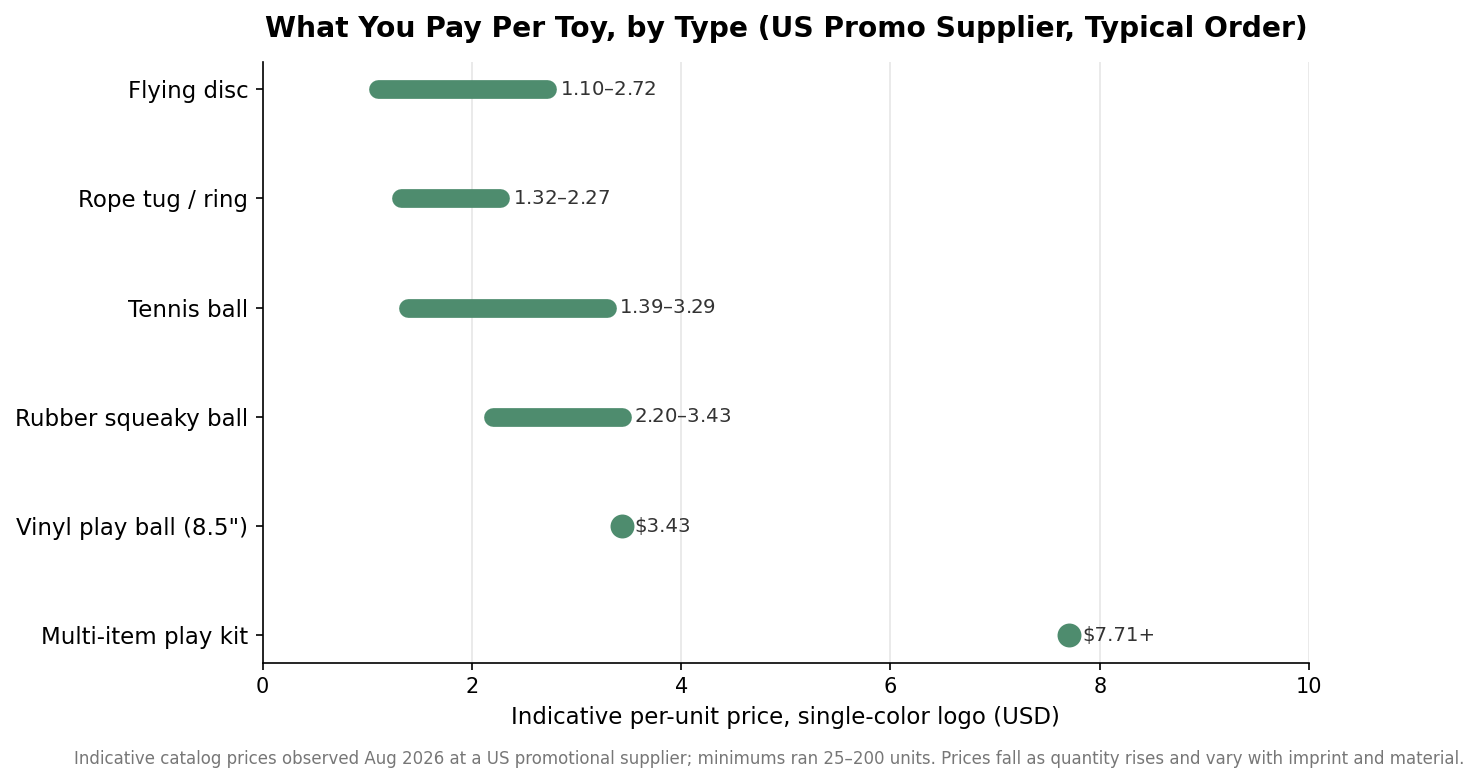
Material choice and toy format drive price more than the imprint does. In current US promotional catalogs, the lightest formats — flying discs and simple rope rings — start around a dollar to a dollar and a half per unit at typical minimums, tennis-ball and squeaky-ball formats land in the low-to-mid single dollars, and multi-item kits climb past seven or eight dollars because you are paying for several pieces plus packaging. Minimum order quantities for these ran roughly 25 to 200 units depending on the item. The figures below are indicative catalog prices for a single-color logo, observed in mid-2026; every one of them falls as you order more, and a full-color or multi-position imprint adds to them.
The practical way to specify a custom dog toy is to start from the dog, not the price. Decide honestly what kind of chewer will receive it, which for a broad giveaway means planning for the strongest jaw likely to show up. That points you at natural rubber or, with supervision, nylon for serious chewers, and at TPR, ETPU, rope, or plush for the gentle-to-moderate majority. Then let format and quantity settle the cost, and treat any single price you are quoted as a starting point that improves with volume. Match the material to the mouth first, and the branding takes care of itself.