Ordering a run of dog toys with your logo on them is not like ordering pens or tote bags. A dog will chew, soak, and shake whatever you hand out, and the wrong material or the wrong imprint turns a good promotional idea into a pile of returns. Whether you run a veterinary clinic, a grooming salon, a pet brand, or a rescue looking for a fundraiser item, the decisions you make before you approve a sample determine whether the toy survives its first afternoon. Here is how to specify a branded dog toy order so it holds up.
Start with the chewer, not the toy
The single most useful thing you can decide up front is what kind of dog is going to receive the toy, because that drives everything downstream. A toy handed out at a small-breed adoption event has a very different life than one given to Labrador and pit bull owners at a supply store. Match the toy to the hardest chewer you expect to reach, not the average one. If even ten percent of recipients are power chewers, a soft plush toy will be destroyed and remembered as a cheap giveaway. Sizing matters for the same reason: a toy should be large enough that it cannot be swallowed or lodged in the throat of the biggest dog likely to get it, which usually means offering at least two sizes if your audience spans breeds.
Decide, too, what the toy is for. Fetch and tug toys, squeaky plush, and dental chews are three different products. A rope toy invites a person to play tug with their dog; a rubber treat-dispensing toy keeps a dog busy alone. The play pattern you want to encourage should shape the shape you order.
Matching material to purpose
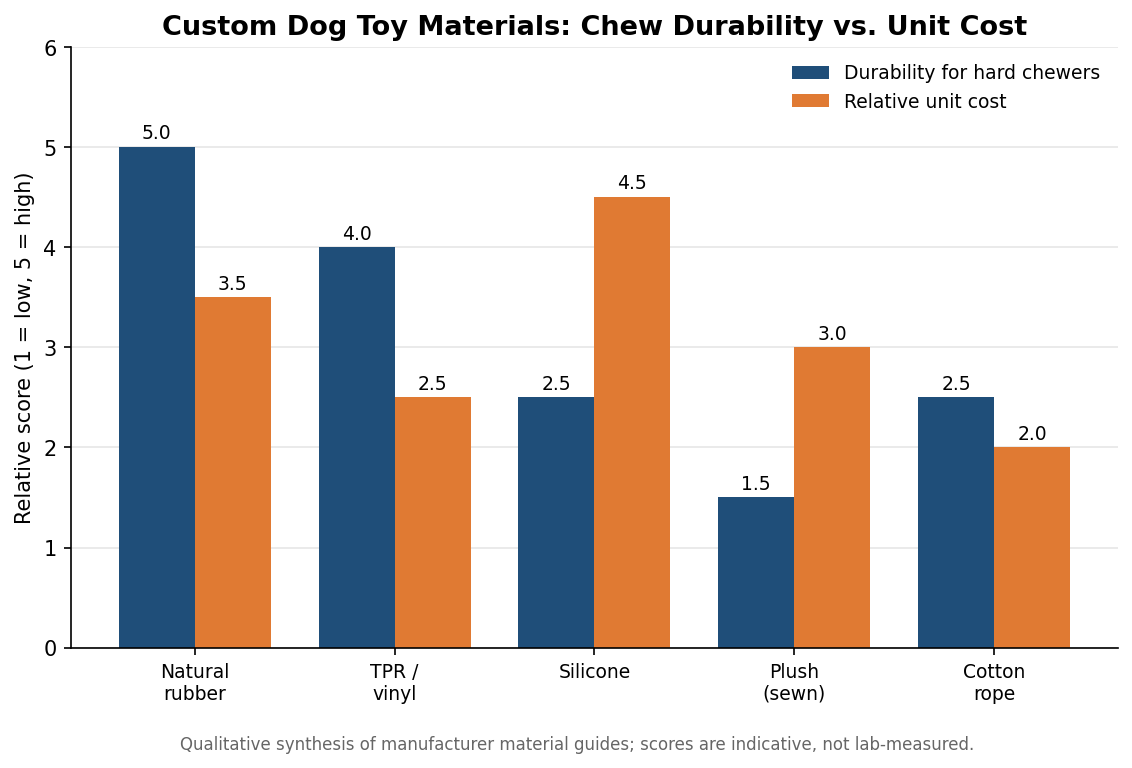
Five materials cover the great majority of custom dog toys, and they are not interchangeable. Natural rubber is the workhorse for chewers: it flexes under a bite and springs back rather than splintering, which both protects teeth and resists breakage, and it is the usual choice for aggressive chewers and large breeds. Its trade-offs are a moderate-to-high unit cost and the fact that natural latex can occasionally trigger an allergy. TPR (thermoplastic rubber) and vinyl are the cost-efficient middle ground, tough and weather-resistant and easy to mold into detailed shapes, though quality varies and cheap TPR can turn tacky or wear quickly. Silicone is the safest material by reputation, food-grade and chemically inert, but it tears under determined biting and belongs with light-to-moderate chewers only. Plush is for cuddling, carrying, and gentle mouthing, not for dogs that gut their toys in minutes. Cotton rope suits tug and fetch and gives a mild flossing action, but frays over time and should be supervised.
The chart below sketches how these materials trade durability against unit cost. Treat the scores as a planning aid rather than a lab result; a well-made TPR toy can outlast a poorly cured rubber one.
Which branding method survives a dog’s mouth
How your logo goes on the toy is as important as the toy itself, because a print that peels is worse than no print at all. Screen and pad printing are the common choices for rubber, TPR, and vinyl; the ink sits on a smooth surface, so simple one- or two-color marks reproduce well while fine gradients and small text do not. Debossing or molding the logo into the surface is the most durable option for rubber toys because there is no ink to wear off, though it reads as a raised or recessed shape rather than a color. Embroidery is the right method for plush and for the woven tags on rope toys, and it carries a brand mark that will not chew away, at the cost of fine detail. Keep the artwork simple: a clean, high-contrast logo in one or two colors survives play far better than a photographic image, and it costs less to set up.
Quantities, lead times, and what drives the price
Most promotional dog-toy suppliers start branded runs at around 100 units, with the exact minimum depending on the material and the decoration method. Production commonly runs about 10 to 15 working days after you approve artwork and a pre-production sample, and you should add transit time on top of that, which can stretch total lead time to several weeks when the goods ship from overseas. Order against your event date accordingly, and build in a week of slack for a sample round.
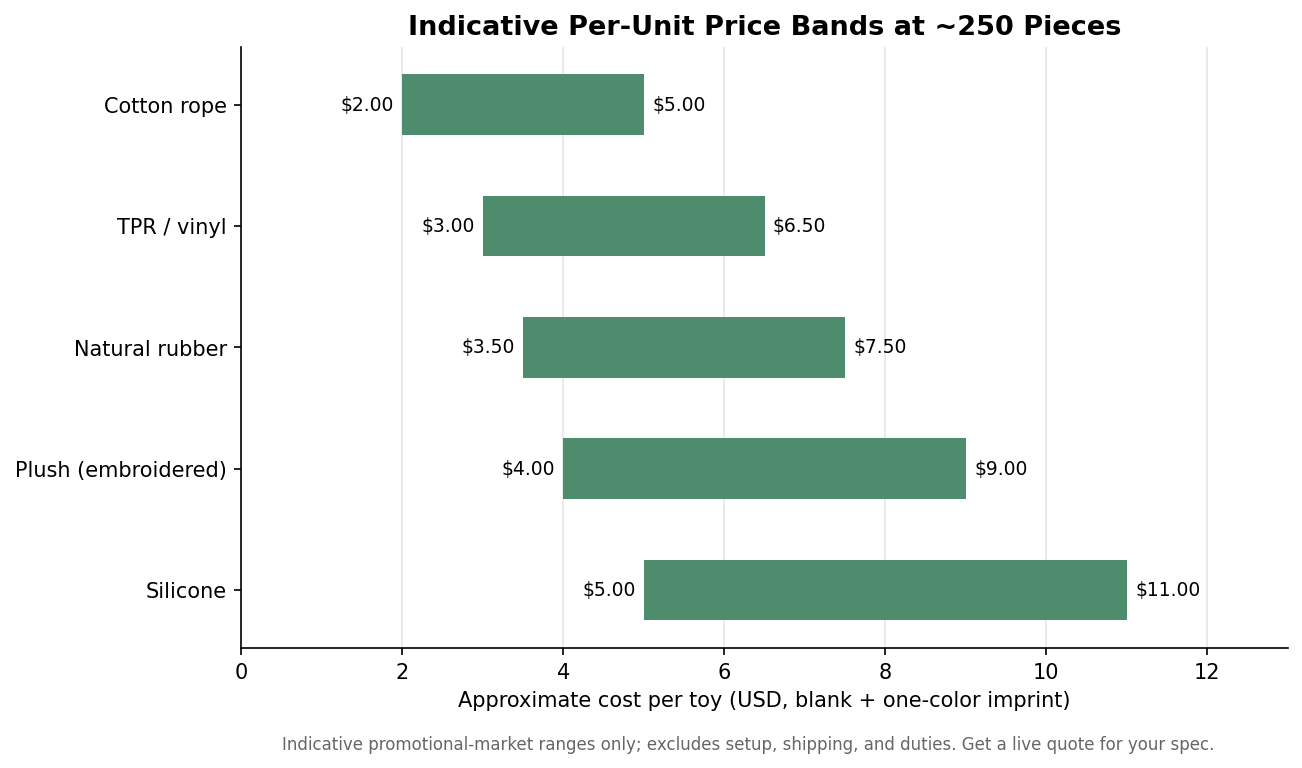
Per-unit price is driven by material, size, the number of imprint colors, and quantity, and it falls as volume rises. The ranges below are indicative of the promotional market for a small-to-medium toy at roughly 250 pieces with a one-color imprint; they exclude setup charges, shipping, and duties, so use them to sanity-check a quote rather than as a price list. Ask every supplier to break out the one-time setup or mold charge separately, because on a first order that fixed cost can be the difference between two quotes that otherwise look identical.
A safety check before you approve the sample
Dog toys are not regulated in the United States the way children’s toys are, so the responsibility for a safe product sits with you and your supplier rather than with a mandatory standard. That makes the pre-production sample the most important step in the whole process. Ask in writing for confirmation that the materials are non-toxic and free of BPA and phthalates, and request documentation if the recipients matter to your brand. When the sample arrives, apply the veterinary rule of thumb for hardness: if you cannot make a slight dent in the surface with a fingernail, or you would not want to be struck on the knee with it, it is hard enough to fracture a dog’s tooth and you should soften the material. Check that seams are secure, that any squeaker is fully enclosed, and that there are no small parts, glued-on eyes, or trim that a dog could pull free and swallow. Only approve the bulk run once a real sample has passed that inspection in your own hands.
Specify the toy around the dog, choose a material and an imprint method that belong together, and treat the sample as a safety gate rather than a formality, and a branded dog toy becomes what you wanted in the first place: a useful thing an owner keeps, with your name on it, long after the event is over.
Leave a Reply