Category: Uncategorized

  • Choosing Dog Toys for a Teething Puppy: What’s Safe at Each Stage

    Choosing Dog Toys for a Teething Puppy: What’s Safe at Each Stage

    A teething puppy will chew whatever is in reach, and the toys you put in front of it during those first six months do two jobs at once: they steer that chewing away from your furniture, and they protect a mouth that is still under construction. The toy that is right for a four-month-old is not the same as the one you would hand a strong-jawed adult, and getting the difference wrong is how puppies end up with cracked teeth or a trip to the vet for a swallowed piece.

    What teething actually is

    Puppies are born toothless. A full set of 28 baby teeth pushes through between roughly two and eight weeks of age, and then the whole set is replaced. Starting around three to four months, those baby teeth loosen and fall out as 42 permanent teeth erupt underneath them, a process most puppies finish by about six months. In other words, a puppy’s mouth is remodeled twice before its first half-year is out, and the sorest stretch is the overlap when adult teeth are pushing through.
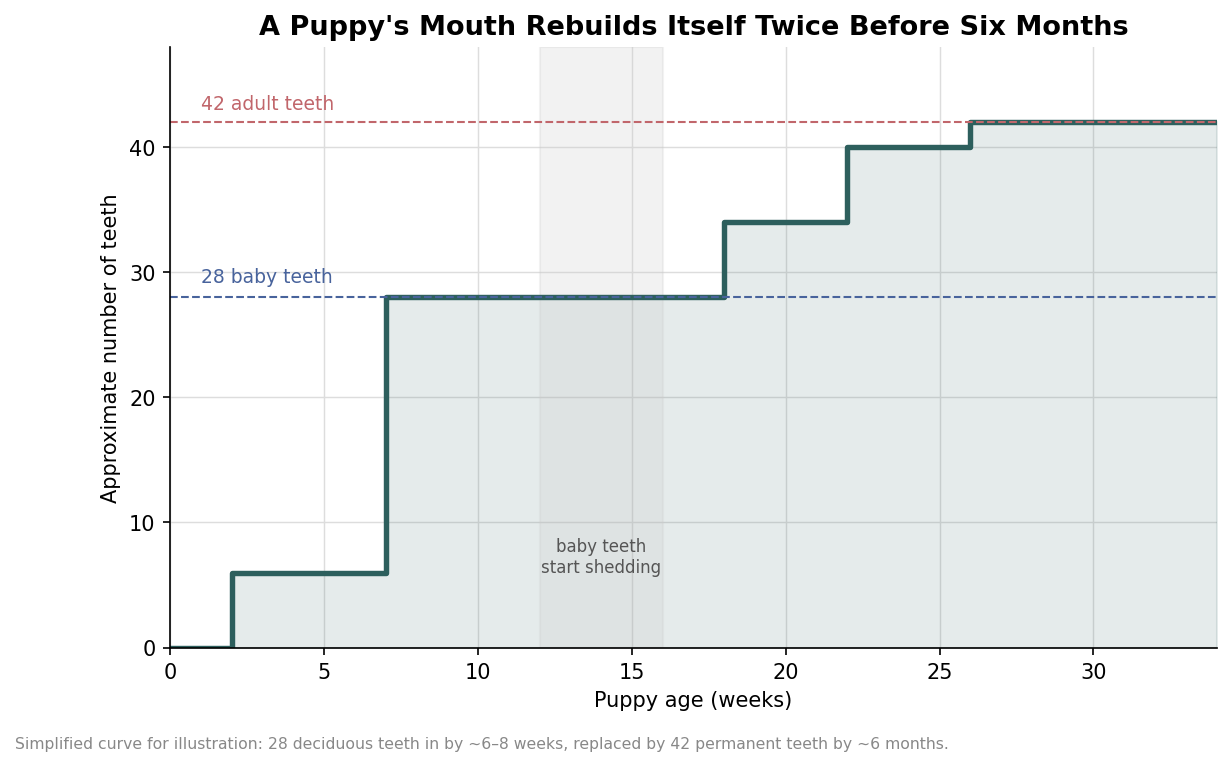
    Step chart of a puppy's approximate tooth count by age, from 28 baby teeth to 42 adult teeth
    A puppy grows 28 baby teeth, then replaces them with 42 adult teeth by roughly six months.

    The different tooth groups do not all arrive at once, which is why chewing intensity comes in waves rather than a single peak. The incisors and canines tend to come through first, the premolars a little later, and the molars last.
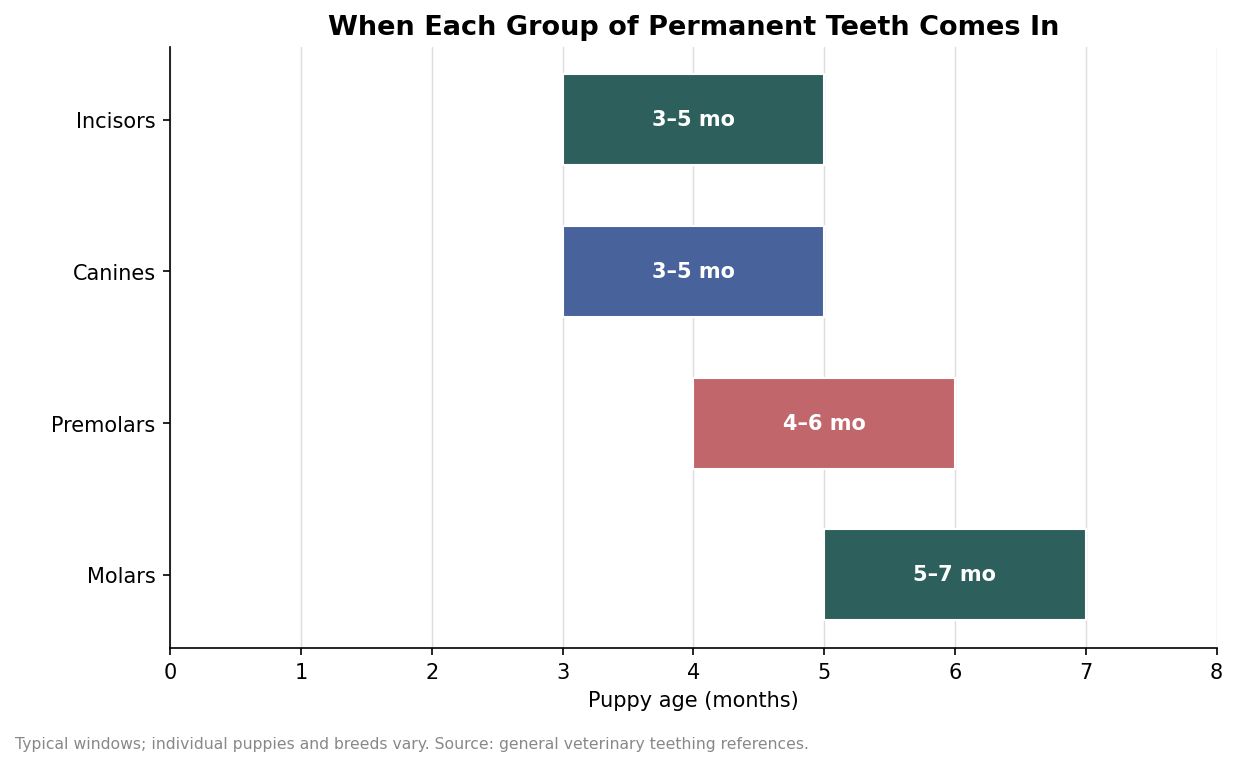
    Timeline chart of when a puppy's permanent incisors, canines, premolars, and molars erupt by month
    Permanent teeth arrive in waves between about three and seven months of age.

    Knowing roughly where your puppy sits on this timeline helps you read its behavior. A sudden jump in chewing, a bit of blood on a toy, or a small tooth found on the floor are all normal signs of the permanent set arriving, not signs that anything is wrong.

    The hardness rule that matters most

    The single most useful test is the thumbnail test: press your thumbnail into the toy, and if the surface does not give at all, it is too hard for a puppy. Developing teeth fracture far more easily than adult teeth, and the usual culprits are exactly the items marketed as long-lasting chews—real bones, antlers, hooves, and the dense nylon toys built for adult power chewers. None of those belong with a teething puppy, however durable they sound, because the same hardness that makes them last is what cracks a young tooth.

    What you want instead is something with a little flex: softer rubber that yields under a thumbnail, rope toys for gentle pulling, and rubber toys with a hollow center you can stuff. A genuinely effective trick for sore gums is cold. Smear a little wet food or peanut butter inside a rubber toy, freeze it, and hand it over—the chill soothes inflamed gums while the filling keeps the puppy working at it, which buys you a quiet twenty minutes and spares a chair leg.

    Sizing, supervision, and what to throw away

    After hardness, size is the thing that sends puppies to the emergency vet. A toy should be clearly too big to fit entirely in the puppy’s mouth, because anything that can be worked to the back of the throat is a choking risk, and puppies are relentless about working at things. Err larger than you think you need, and step up toy sizes as the puppy grows rather than assuming last month’s toy still fits.

    Supervision is not optional during this stage. Puppies swallow squeakers, tear the fabric off plush toys, and gnaw rope until strands come loose, and any of those can lodge in a digestive tract that is smaller and less forgiving than an adult dog’s. Check toys over regularly, and retire anything that has started to shed pieces, split at a seam, or shrink small enough to swallow. A toy that was perfect two months ago can quietly become a hazard. A simple habit that prevents most trouble is a quick weekly look through the toy basket, tossing anything cracked, frayed, or worn down, so the collection the puppy plays with is always one you have actually checked.

    It also helps to keep more toys in rotation than the puppy has access to at any one time. Put three or four out, cycle the rest away for a week, and swap them—a toy that has been out of sight reads as new again, which keeps a bored puppy engaged with its own things instead of testing the baseboards. When you do catch the puppy chewing something off-limits, the fix is to trade rather than scold: calmly take the forbidden item, hand over an approved toy, and praise the switch, so the puppy learns where its teeth are welcome.

    If you are ordering custom or branded puppy toys

    Businesses that hand out toys—breeders sending puppies home, vet clinics welcoming new patients, brands building a puppy line—have the same constraints as any owner, plus one more. The material has to stay soft enough to pass the thumbnail test even after you add printing or molding, so specify a puppy-appropriate rubber rather than defaulting to the harder compound used for adult chew toys. Keep any printed branding on surfaces the puppy is not meant to gnaw, and size the toy for the smallest animal likely to receive it, not the average, since a giveaway ends up in a lot of different mouths.

    Order a sample and put it through the same checks you would use at home before committing to a run. Press a thumbnail into it, look at how the seams and any squeaker are secured, and confirm it is too large for a small puppy to swallow. Those three checks take a minute and are far cheaper to act on with one sample in hand than with a pallet already printed and boxed.
  • Custom Dog Toys as Giveaways: Choosing the Right Toy for Vet Clinics, Shelters, Boarding, and Pet Brands

    Custom Dog Toys as Giveaways: Choosing the Right Toy for Vet Clinics, Shelters, Boarding, and Pet Brands

    The dog toy that works as a front-desk giveaway at a veterinary clinic is rarely the one a boarding kennel should hand out, and neither is what a pet brand wants tucked into a retail bundle. On a catalog page they all sit in the same category, but the use case quietly changes almost every specification that matters: unit cost, durability, imprint size, and how many you have to buy at once. This guide walks through the four business situations behind most custom dog toy orders and what each one should lock down before requesting a quote.

    Start with how the toy gets handed out

    The handoff context drives the whole decision. A toy that lives in a bowl on a reception counter needs to be cheap, small, and light to store, because you will give away hundreds and reorder often. A toy handed out at a booth or adoption event needs to catch the eye across a crowded room and carry your logo clearly. A toy tucked into a retail bundle has to feel worth the shelf price it rides on. And a toy going home with a newly adopted dog has to be safe and durable on a tight budget. Decide the handoff first, and most of the other specifications fall into place on their own.

    The four use cases and what each one should prioritize

    Vet clinics and groomers are running counter giveaways. The winning pick is usually a simple ball, tennis ball, or small squeaker at the low end of the price range, because volume and reorder frequency matter more than novelty. Imprint area on these small toys is genuinely tiny, often around half an inch by an inch and a quarter, so a clean one-color mark of your name or paw logo reads far better than a detailed full-color design that will only blur.

    Shelters and rescues need budget durability. The toy is going into a shared or high-stress environment, so rope and nylon styles that tolerate rough handling tend to outlast plush. Safety deserves real attention here: pet toys in the United States are not held to the same federally mandated safety testing as children’s toys, so the burden is on the buyer to ask about non-toxic materials, secure seams, and choke-sized parts rather than assuming a standard covers it.

    Boarding, daycare, and training operations are buying for genuine chewers and should expect wear. Rubber and nylon chew styles hold up best, and the smart move is to treat these as consumable, buying in enough volume that replacing a chewed toy costs pennies rather than planning for any single toy to last forever. Match the toy’s stated chew rating to the strongest dogs you actually board, not the average.

    Pet brands and retail sellers are the one group that should spend up. Here the toy represents the brand on a shelf next to competitors, so consistent color, a premium material, retail-ready packaging, and sometimes a fully custom mold are worth the added cost and time. This is also the only use case where the longest production paths usually make sense.

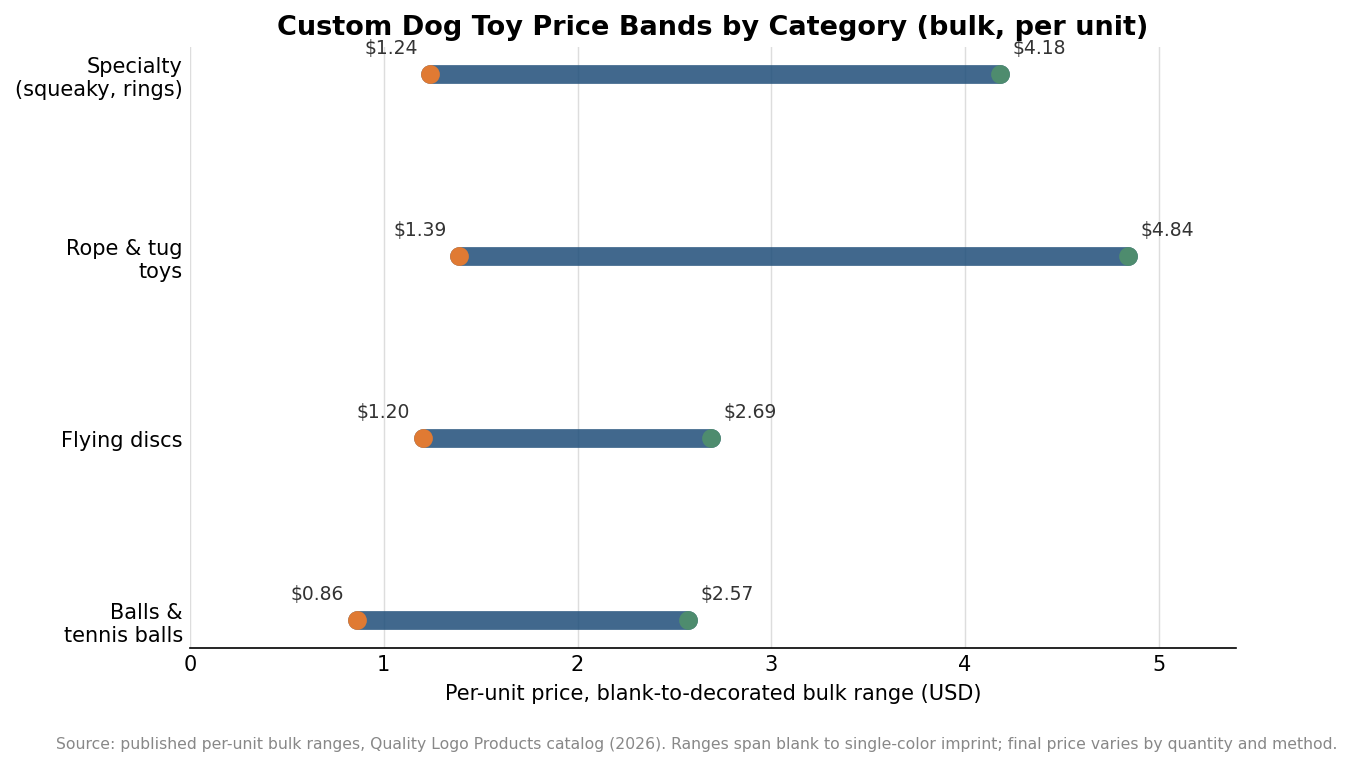
    Range chart of per-unit bulk prices for custom dog toy categories: balls, discs, rope, and specialty toys
    Balls sit at the low end of per-unit cost; rope and specialty squeaky toys run highest.

    Quantities and what you will actually pay

    Minimum order quantities for decorated dog toys generally start somewhere between about 100 and 144 units, depending on the supplier and the decoration method, with lower minimums on simple imprints and higher ones on anything molded. Per-unit pricing tracks the category more than anything else. Plain balls and tennis balls sit at the bottom, roughly under a dollar to around two and a half dollars each in bulk, while rope, tug, and specialty squeaky toys climb into the three to five dollar range. Those figures are indicative catalog ranges rather than a quote for your exact art, and they compress as you move from a starter run into the several-hundred and thousand-unit brackets, so if a giveaway program is ongoing it is usually worth pricing the next tier up before committing to the minimum.

    Match the decoration method to the toy

    How your logo goes on depends on the surface. Screen and pad printing suit smooth rubber and vinyl, embroidery and woven labels belong on plush and fabric, and embossing or debossing works on molded rubber where a printed mark would rub off. Heat transfer covers full-color art on the right substrate. Two constraints matter most when you specify: the imprint area is small, ranging from that half-inch mark on tiny toys up to roughly three and three-quarter inches across on larger items, and whatever you print has to survive a mouth. Placing the logo on a handle, panel, or end that sees less direct chewing will keep it legible far longer than centering it on the part the dog actually bites.

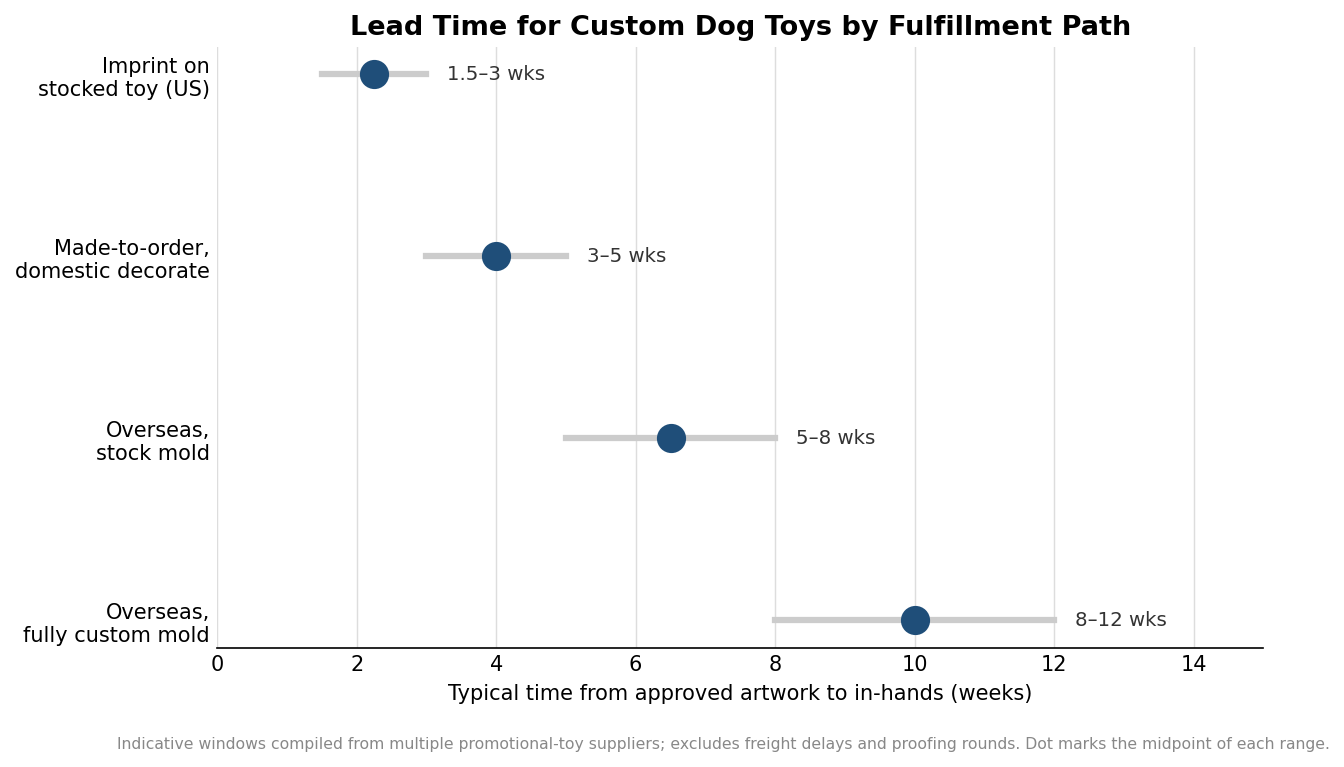
    Chart of typical lead-time windows in weeks for four custom dog toy fulfillment paths
    Imprinting a stocked toy is fastest; a fully custom mold takes the longest to reach your hands.

    Lead time is the number that derails events

    The single most common ordering mistake is backing into an event date. Imprinting a logo onto a toy a supplier already stocks domestically is the fast path, often around one and a half to three weeks once artwork is approved. A domestic made-to-order decoration runs closer to three to five weeks, an overseas run on an existing mold roughly five to eight, and a fully custom molded toy commonly eight to twelve weeks or more before freight. Those windows exclude the proofing rounds and any shipping delays, so plan backward from the in-hands date you actually need, add a buffer for a revised proof, and confirm the real timeline in writing before you count on toys arriving for a specific weekend.

    Putting it together

    Before you request a quote, settle five things in order: the use case and how the toy will be handed out, the per-unit cost you can live with, the quantity that both clears the minimum and matches your program, the toy type and material suited to the dogs receiving it, and the decoration method with print-ready art already prepared. Bring those to a supplier and the conversation turns into a single accurate quote instead of three rounds of back-and-forth, and the toys that show up will fit the job you bought them for.

  • Custom Dog Toy Materials: How Rubber, Nylon, Rope, and Plush Compare on Durability, Safety, and Cost

    Custom Dog Toy Materials: How Rubber, Nylon, Rope, and Plush Compare on Durability, Safety, and Cost

    The material a custom dog toy is molded or sewn from decides almost everything that matters after the logo goes on: how long it survives a determined chewer, whether it is safe in the mouth of the dog it reaches, how easily it washes, and what it costs you per unit. Two toys can carry the same imprint and look nearly identical in a catalog photo while behaving completely differently in a living room. This guide walks through the materials you will actually be quoted on, what each one is good and bad at, and how the choice moves your price.

    Natural rubber: the default for dogs that actually chew

    Natural rubber is the workhorse of the custom chew-toy world for good reason. It is flexible, non-toxic, and forgiving on teeth and gums, which means a dog can work it hard without the sharp-fracture risk that harder plastics carry. Molded rubber also holds a debossed or recessed logo well, and hollow versions double as treat dispensers, which keeps a branded toy in front of the dog longer. It suits medium to heavy chewers and cleans up easily with soap and water. The tradeoff is weight and cost: solid rubber uses more material than a thin synthetic shell, so a rubber toy of any real size sits toward the upper half of the price range. If your giveaway is going to dogs whose owners describe them as “destroyers,” rubber is usually the safest specification that still survives.

    Nylon and the hardness tradeoff

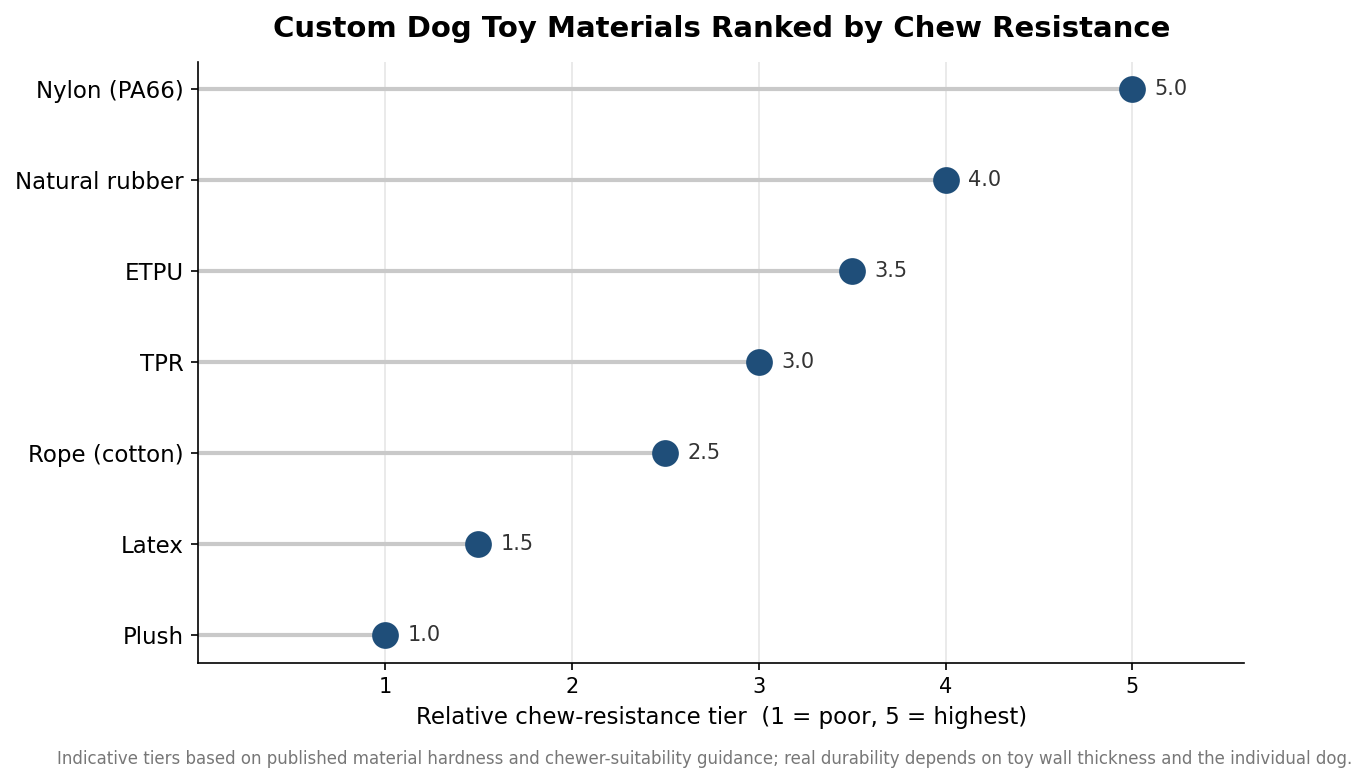
    Nylon is the hardest material on most pet-toy line sheets, and that hardness cuts both ways. The PA66 grade is meaningfully stronger than standard PA6 and can stand up to aggressive chewing that would shred anything softer. But hard is not the same as safe. A material rigid enough to resist an aggressive chewer is also rigid enough to chip a tooth, and when pieces do break off they can splinter rather than deform. Reputable suppliers position nylon for genuinely powerful chewers under supervision, not for dogs with soft mouths or for unsupervised handout scenarios. If you are ordering toys to give away at an event where you have no idea what breed picks one up, nylon is a riskier default than rubber, even though it wins a pure durability contest.

    That durability contest is worth seeing laid out, because the ranking is fairly stable across suppliers even though the exact wording changes.

    Dot plot ranking custom dog toy materials by chew resistance, nylon highest and plush lowest
    Nylon and natural rubber lead on chew resistance; plush and latex sit at the bottom.

    TPR, ETPU, and latex: the softer synthetics

    Between hard nylon and soft plush sits a family of engineered rubbers that most branded squeaky toys, balls, and flyers are made from. TPR, or thermoplastic rubber, is non-toxic, pleasantly flexible, and inexpensive to mold, which is why so much light-to-moderate promotional product is made from it. It is a fine choice for tuggers and casual chewers but is not marketed for heavy jaws. ETPU, an expanded polyurethane, is the bouncy, lightweight material behind many fetch and chase toys; it carries good tear resistance for its weight and is often described as hypoallergenic, which matters for sensitive dogs. Latex is the softest of the three, prized for its squeak and give, but it tears easily under strong jaws and a minority of dogs react to it, so it belongs with gentle players. None of these three is the answer for a power chewer, but for the vast middle of the dog population they hit a sensible balance of safety, feel, and price.

    Rope and plush: when soft is the point

    Not every toy is trying to survive a chewer. Rope toys made from braided cotton are built for tugging and interactive play, and a natural-fiber rope is generally safe, with one real caveat: frayed strands can be swallowed, so rope is a supervised-play product rather than a leave-it-in-the-crate one. Rope also takes branding through a woven or printed tag rather than on the toy body itself. Plush sits at the soft extreme. It is wonderful for gentle chewers and cuddlers and it shows a full-color logo better than almost anything else, since you are printing on fabric, but it offers essentially no chew resistance and the stuffing is an ingestion hazard once a seam gives way. Plush is the right call for a comfort-toy or mascot giveaway and the wrong call for anything aimed at dogs that bite down hard.

    What the material does to your unit cost

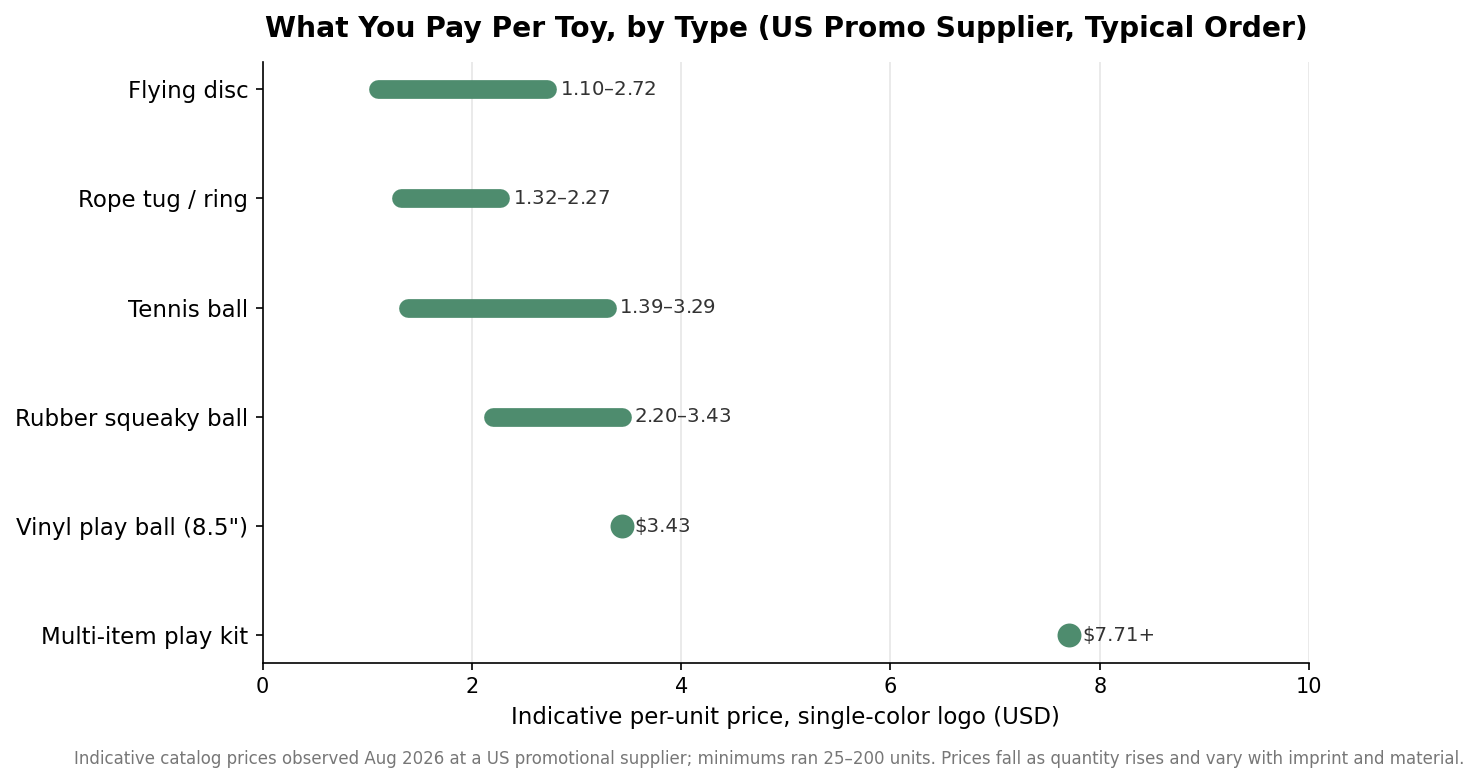
    Material choice and toy format drive price more than the imprint does. In current US promotional catalogs, the lightest formats — flying discs and simple rope rings — start around a dollar to a dollar and a half per unit at typical minimums, tennis-ball and squeaky-ball formats land in the low-to-mid single dollars, and multi-item kits climb past seven or eight dollars because you are paying for several pieces plus packaging. Minimum order quantities for these ran roughly 25 to 200 units depending on the item. The figures below are indicative catalog prices for a single-color logo, observed in mid-2026; every one of them falls as you order more, and a full-color or multi-position imprint adds to them.

    Horizontal range chart of indicative per-unit prices for custom dog toys by type
    Indicative single-color per-unit prices by toy format at typical US promo minimums.

    The practical way to specify a custom dog toy is to start from the dog, not the price. Decide honestly what kind of chewer will receive it, which for a broad giveaway means planning for the strongest jaw likely to show up. That points you at natural rubber or, with supervision, nylon for serious chewers, and at TPR, ETPU, rope, or plush for the gentle-to-moderate majority. Then let format and quantity settle the cost, and treat any single price you are quoted as a starting point that improves with volume. Match the material to the mouth first, and the branding takes care of itself.

  • How to Choose Custom Dog Toys by Chew Strength and Play Style

    How to Choose Custom Dog Toys by Chew Strength and Play Style

    A dog toy only works if it matches the dog. The most beautifully branded plush toy is landfill within an hour in the jaws of a determined Labrador, and the toughest nylon bone is a waste of money and a dental hazard for a gentle senior who just wants something soft to carry. If you are building a custom dog toy line, the smartest thing you can do before choosing colors and logos is decide which dogs each toy is for, and let that drive the material and format. This is a selection guide organized the way buyers actually shop: by how the dog plays and how hard it chews.

    Start by classifying the chewer, not the breed

    Dogs sort roughly into three chewing intensities, and this matters more than size or breed. Gentle chewers mouth and carry toys without trying to destroy them; they are happy with soft, plush, and squeaky items. Moderate chewers work a toy actively and will find the weak seam, but they are not on a mission to reduce it to fragments. Power chewers, the category most likely to generate an angry review, treat every toy as a problem to be solved with force, and they defeat anything that is not purpose-built. A single household can contain all three, which is why offering a line that spans intensities sells better than a one-size product. Ask buyers to self-identify their dog’s intensity on the product page, because they know it, and it routes them to the right item.

    Match the material to the intensity

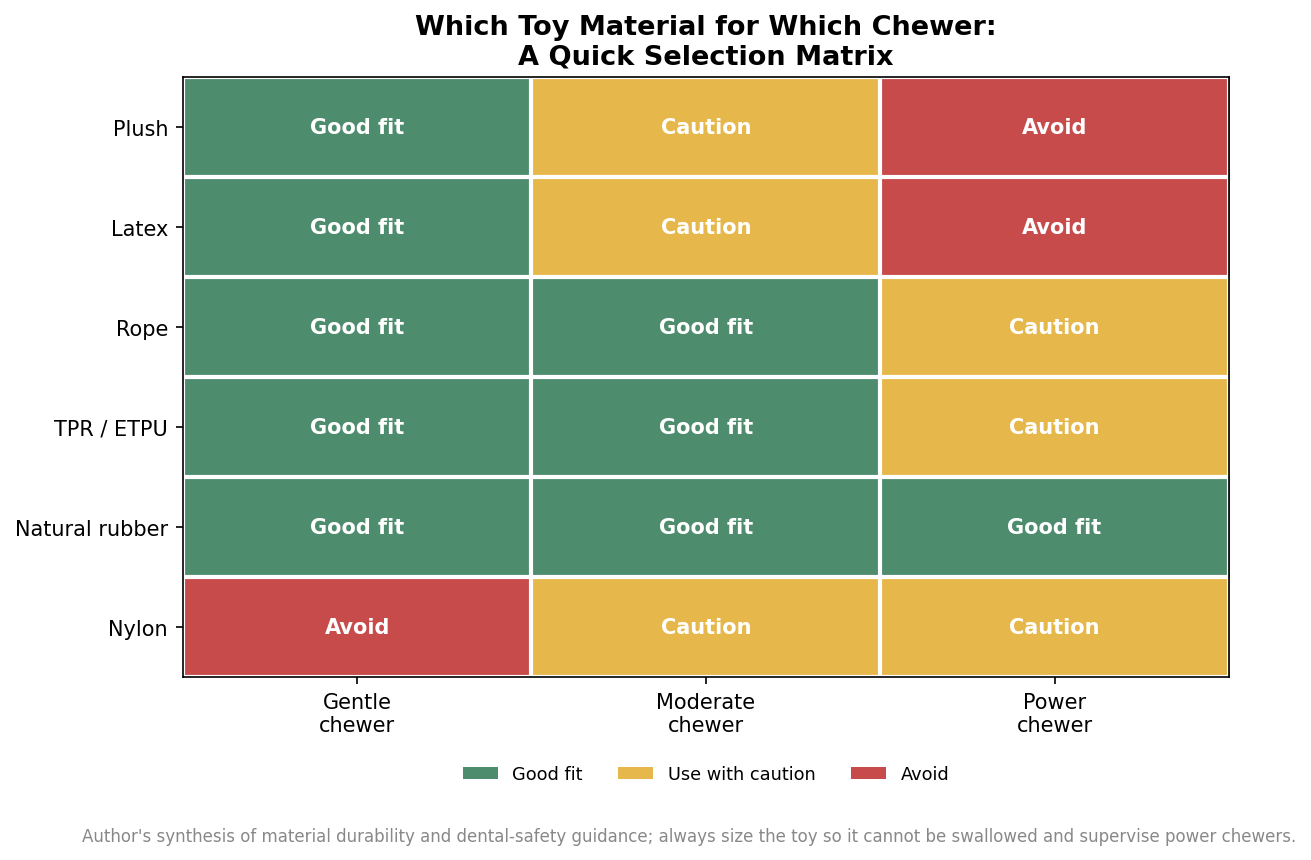
    Materials line up along a durability spectrum, and each has a natural home. Plush and latex sit at the soft end: pleasant, squeaky, and easily destroyed, so they suit gentle chewers and supervised play only, with the real risk being ingested stuffing or a swallowed squeaker. Rope is a moderate-duty material good for tug and some dental benefit, but frayed strands can cause digestive trouble if swallowed, so worn rope toys need retiring. Thermoplastic rubber and expanded thermoplastic polyurethane are flexible, bouncy, and non-toxic, ideal for small-to-medium dogs and chase-and-tug play. Natural rubber is the versatile workhorse: durable enough for medium and heavy chewers, flexible enough to spare teeth, and often designed to be stuffed with treats for enrichment. Nylon is the most durable option and the one aggressive chewers cannot easily destroy, but it is hard, and hardness is a double-edged sword.

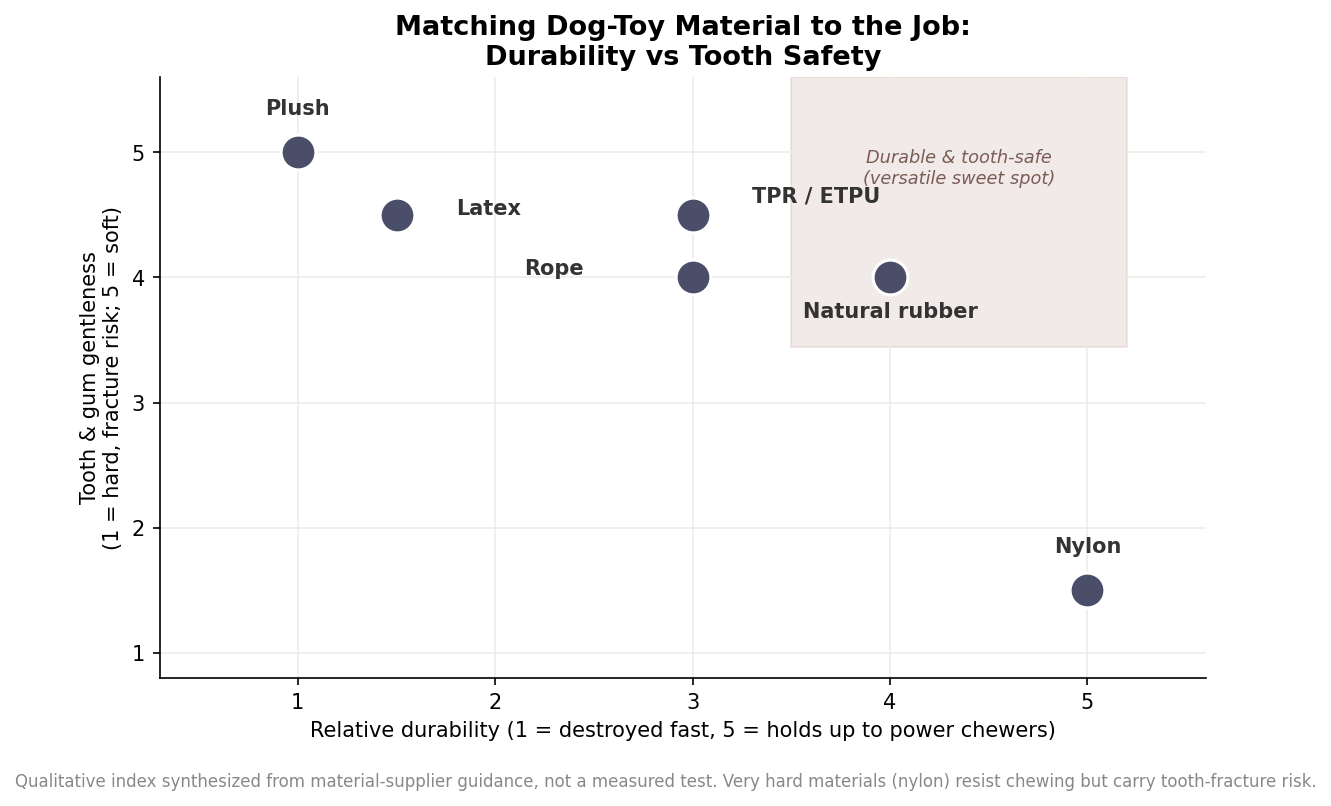
    Scatter chart plotting dog toy materials by relative durability and tooth gentleness, with natural rubber in the durable-and-safe sweet spot
    Toy materials plotted by durability against tooth safety; natural rubber sits in the versatile sweet spot.

    The hardness caution is worth stating plainly. A toy that is too hard to dent with your thumbnail is hard enough to fracture a tooth. Nylon, hard plastic, real bones, and antlers all fall into this zone. They resist chewing precisely because they are unyielding, and that same property transmits force back into the dog’s teeth. For a power chewer you often want the toughest thing available, but you should pair it with guidance to supervise, to choose the right size, and to accept that even nylon wears and needs replacing. Natural rubber earns its reputation as the default recommendation because it lands in the sweet spot: genuinely durable while still having enough give to be kind to teeth and gums.

    Then match the format to the play style

    Intensity tells you the material; play style tells you the format. Chewers want a chew toy they can settle in with, which points to solid or stuffable rubber and nylon shapes. Retrievers want fetch toys, so balls, rings, and bumpers in bouncy rubber or buoyant foam suit them, sized so they cannot lodge in the throat. Dogs that love a wrestle want tug toys with handles and reinforced stitching, where rope and tough braided fabric shine. And the fastest-growing category, enrichment, wants puzzle and treat-dispensing toys that make the dog work for a reward. Enrichment toys deserve special attention in a modern line because they address boredom and destructive behavior directly, and because treat-dispensing rubber doubles as a durable chew, giving you a single item that serves two needs.

    Selection matrix showing which dog toy materials suit gentle, moderate, and power chewers
    A quick selection matrix matching toy materials to gentle, moderate, and power chewers.

    Size and supervision are non-negotiable

    Whatever the material, size is the safety spec that prevents the worst outcomes. A toy should be large enough that the dog cannot fit it entirely in its mouth or swallow it, and small enough to grip and carry comfortably. The dangerous middle is a toy that is just small enough to become lodged in the throat, which is a genuine choking and obstruction risk. Size up rather than down when a dog is between sizes, and offer distinct sizes rather than a single medium that fits nothing well. Alongside size, build replacement and supervision into your product messaging: any toy showing fraying, tears, or missing chunks should come out of rotation immediately, and power chewers should be supervised with any toy, because no toy is truly indestructible.

    Turn the framework into your product line

    Put these pieces together and your catalog almost designs itself. Cover the gentle end with plush and latex squeaky toys aimed at light chewers and puppies. Serve the broad middle with natural rubber chews, rubber fetch balls, and rope tugs that suit most dogs. Anchor the tough end with heavy natural rubber and nylon built for power chewers, sold honestly as durable rather than indestructible and paired with a dental caution. Layer enrichment across the whole range with treat-dispensing and puzzle toys, since those sell to owners of every chewer type. Then apply your branding where it survives, size each item into a real range, and label the intended chewer intensity on every product. A line organized around how dogs actually play, rather than around what looks good in a photo, is the one that earns repeat orders.

  • Dog Toy Safety: Materials, Sizing, and the Regulation Gap Nobody Mentions

    Dog Toy Safety: Materials, Sizing, and the Regulation Gap Nobody Mentions

    Here is a fact that surprises most dog owners: in the United States there is no federal safety standard for pet toys. Children’s toys are tested for lead, choking hazards, and toxic chemicals before they can be sold; the squeaky rubber bone in the same shopping cart faces no such requirement. That gap does not make every dog toy dangerous, but it does shift the responsibility onto the buyer to read materials, sizing, and construction the way a regulator otherwise would. This guide walks through what to actually check.

    Nobody is checking the ingredients

    Because pet toys are largely unregulated, what a toy is made of matters more than any marketing claim on the packaging. The materials to avoid are well documented. PVC and vinyl are usually softened with phthalates, and as a dog chews, those phthalates can seep out and be absorbed through the gums, a concern that toxicologists link to reproductive and developmental effects and that matters most for puppies. BPA, found in some plastics, is associated with hormone disruption. Lead can hide in painted details, chromium and cadmium in cheap dyes, and formaldehyde in the adhesives holding parts together, all of which have turned up in forensic testing of imported toys sold at major retailers.

    The safer end of the shelf is easier to navigate than it looks. Natural rubber, organic cotton, and heavy-duty nylon are the materials most often recommended, and the labels worth trusting say BPA-free, phthalate-free, and lead-free in plain language. Because no law forces testing, the strongest signal a brand can send is voluntary proof: some publish independent lab results for toxins, and some hold third-party certifications. When two toys look identical, the one whose maker documents its testing is the safer bet.

    The size mistake that causes choking

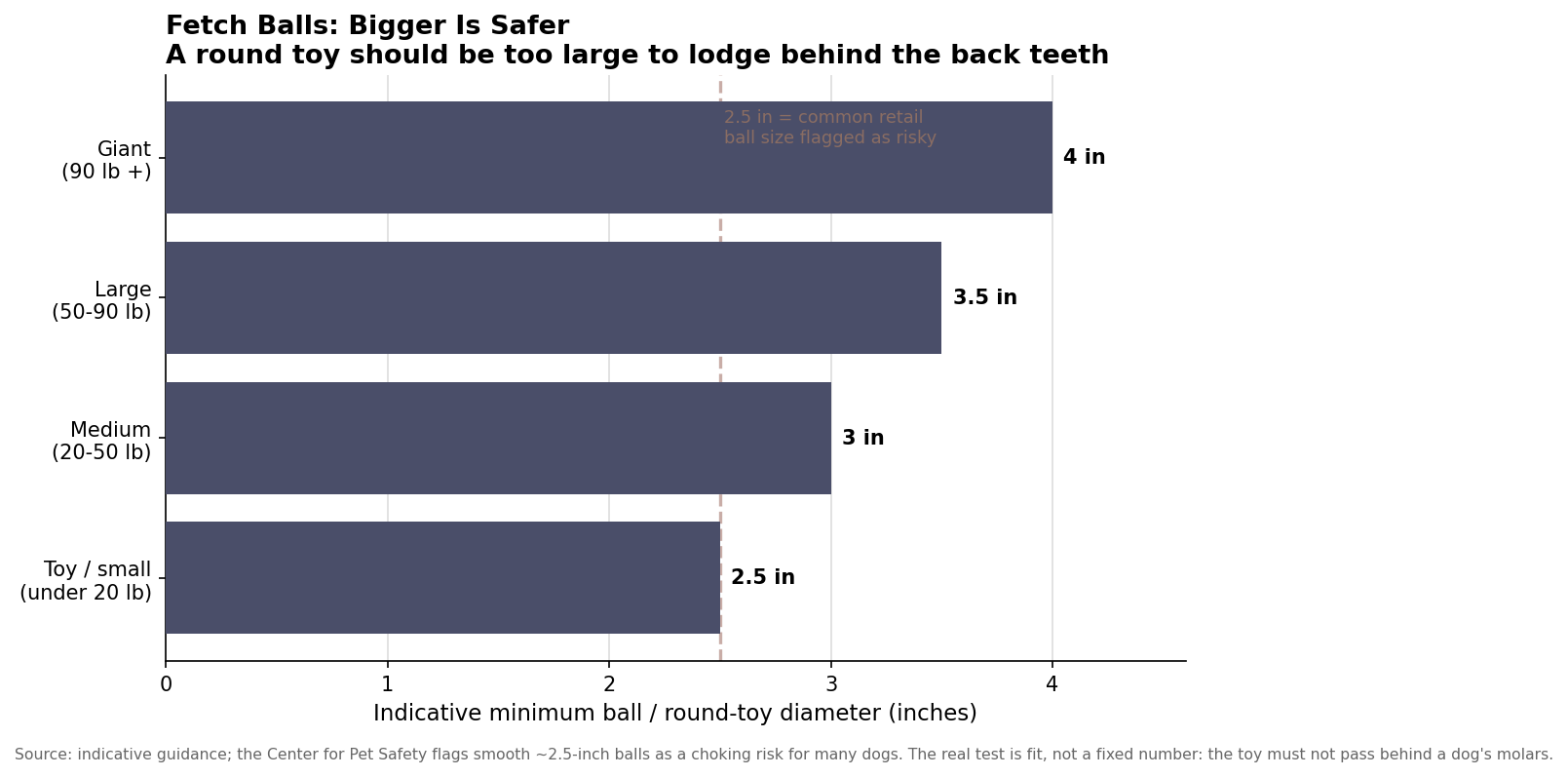
    The most dangerous thing about a toy is often not its chemistry but its size. A ball that a dog can get most of the way into its mouth can slide back and lodge in the throat, and once saliva lubricates a smooth, heavy ball, it becomes nearly impossible for the dog to expel; safety investigators describe a near-total fatality rate in these incidents. The catch is that the most common ball size on retail shelves, around 2.5 inches across, is small enough to be a genuine hazard for many medium and large dogs.

    The rule is not a single magic number, it is fit: a round toy should be too large to pass behind your dog’s back teeth. Size up rather than down, be especially wary of smooth, solid, heavy rubber balls for powerful dogs, and skip any toy with small attached parts like buttons, plastic eyes, or ribbons that can be chewed off and swallowed.

    Horizontal bar chart of indicative minimum fetch-ball diameter by dog size, with a reference line at the risky 2.5-inch common retail size
    Indicative minimum ball diameter by dog size; the common 2.5-inch ball is too small for many dogs.

    How hard is too hard

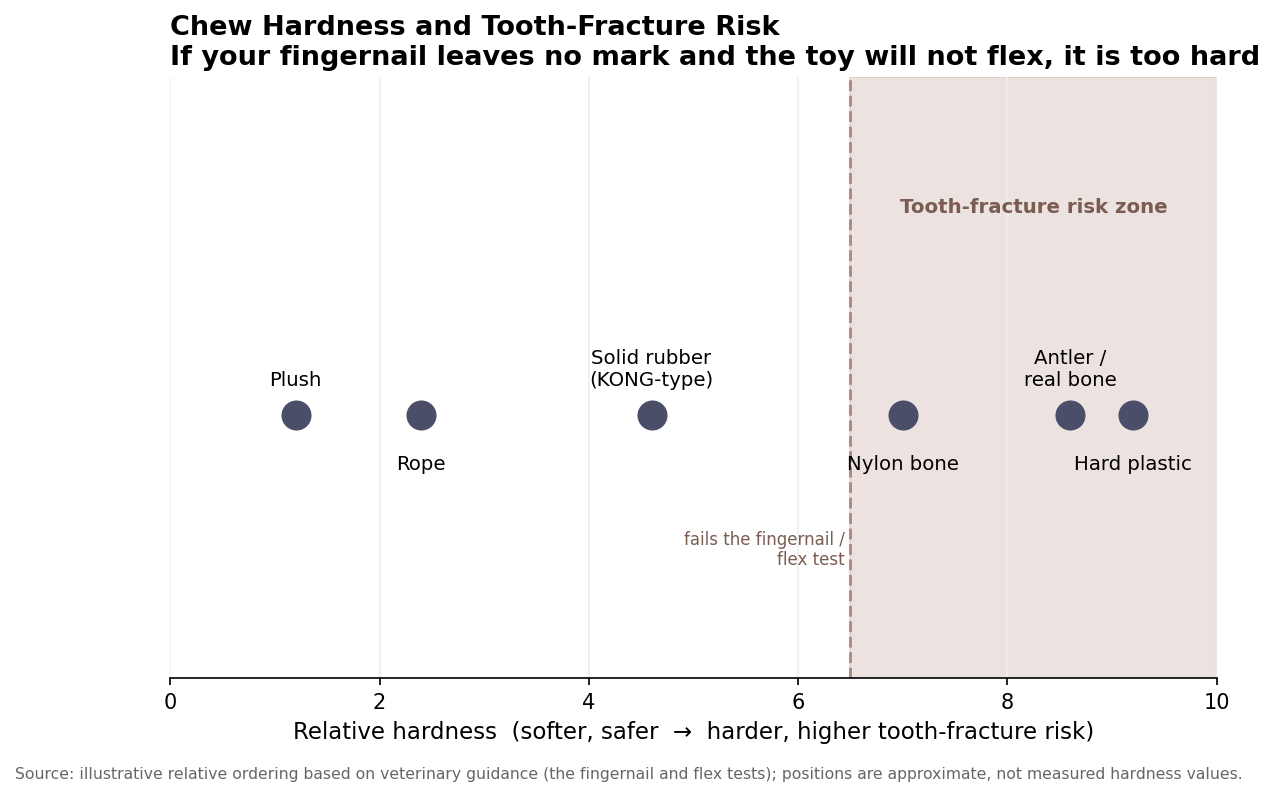
    Chews that are too hard crack teeth, and a fractured tooth is a painful, expensive vet visit. The field test veterinarians recommend takes two seconds. Press your fingernail into the toy: if it leaves no mark, and if the toy will not flex at all in your hands, it is too hard for your dog’s teeth. That test quietly rules out most of the hardest items on the market, including antlers, real bones, thick nylon bones, and rigid plastic chews. Softer, forgiving materials such as quality rubber flex under pressure and spread the force instead of concentrating it on a single tooth.

    This does not mean giving up on durable chews for a dog that needs to gnaw. It means choosing ones that have some give: firm rubber chews built for aggressive chewers, or dental chews that carry a veterinary acceptance mark, satisfy the urge without the rigidity that shears a tooth. If you do offer something harder for a short, supervised session, watch closely and take it away the moment your dog switches from gnawing with the front of the mouth to bearing down with the back molars, which is where fractures happen.

    Dot plot placing common chew toys on a relative hardness axis with a shaded tooth-fracture risk zone above the fingernail-test threshold
    Where common chews fall on relative hardness; items past the fingernail-and-flex test carry tooth-fracture risk (illustrative).

    Squeakers, stuffing, and rope

    Some hazards are about what is inside the toy rather than what it is made of. Dogs with a strong prey drive often see the point of a plush toy as the squeaker, and a swallowed squeaker or a mouthful of polyester stuffing can cause an intestinal blockage that needs surgery. Rope toys carry their own risk: as they fray, dogs swallow long strands that can bunch in the gut and cause a dangerous obstruction. None of this means these toys are off-limits, but it does mean they belong to supervised play. Hand them out when you are watching, and put them away when you are not.

    Reading a label and knowing when to toss

    Put together, a safe toy is one you have vetted on four fronts: the material is non-toxic and clearly labeled, the size is too big to swallow, the hardness passes the fingernail-and-flex test, and there are no small parts or loose fill waiting to come off. Match that to your specific dog, because a toy that is perfect for a gentle senior can be genuinely unsafe for a young power chewer.

    The last habit is the one people skip: retire toys before they fail. Throw a toy away once it is cracked, once pieces are breaking off, once the stuffing or squeaker is exposed, or once a ball has been chewed down small enough to swallow. A worn-out favorite feels harmless, but that is exactly the toy that turns into an emergency. In a market with no safety net behind it, a two-minute inspection before and after play is the closest thing your dog has to a regulator, and it is the cheapest insurance you can buy.

  • Chew-Proof Branding: What Survives a Dog

    Call or Text us: (929) 605-4397
    Specs

    Chew-Proof Branding: What Survives a Dog

    The question every buyer asks

    Every buyer asks the same question: will the logo last? The answer depends entirely on where the branding lives on the toy, and it is the difference between a product that represents you and one that embarrasses you.

    Three ways branding survives

    Embroidery pushes the mark into the fabric with thread, so it wears at the same rate as the toy. Molded embossing makes the logo part of the rubber’s shape — there is nothing to peel. Dyed rope strands carry color through the whole fiber, so the palette is the product.

    The one way it fails

    Surface printing on a chewing surface. Teeth are abrasive, saliva is wet, and a printed film on a chew toy is gone within days. We print only where mouths mostly are not: felt ball panels, disc faces and tags — and we say so honestly on the mockup.

    Safety is part of durability

    A durable toy that sheds parts is worse than a worn one. Pet-safe fill, no loose plastic parts on plush, natural rubber without coatings, and pet-grade felt are the baseline for everything we make.

    Specify it right

    Tell us the dogs the toys are for — gentle mouths, daily players or destroyers — and we will match the format. Minimum order is 12 toys, the mockup is free within 24 hours, and production runs 2 weeks.

    Create your custom dog toys now.

    Send your logo, quantity and date — you’ll get a free mockup and quote within one business day.

    Get a Quote
    GET A QUOTE
  • Why Pet Businesses Give Away Dog Toys

    Call or Text us: (929) 605-4397
    Business

    Why Pet Businesses Give Away Dog Toys

    The giveaway that goes to the park

    The dog toy is the rare giveaway that gets used daily, photographed constantly and carried into the most social space in the neighborhood: the dog park. A branded ball thrown at the park is seen by every owner standing in the circle.

    Owners post their dogs, not your ads

    Nobody shares a photo of a branded pen. People post their dog with a new toy relentlessly, and a mascot plush or a replica of your product is designed to be exactly that photo. It is organic reach you did not have to buy per impression.

    The vet’s and groomer’s advantage

    A toy handed over at the end of an appointment reframes the visit — the dog leaves happy, the owner remembers why. It is the cheapest loyalty program in the industry, and the toy sits in the house repeating your name for months.

    Adoption days run on toys

    For shelters, the toy in the adoption photo is part of the story people share. A branded toy in every adoption pack puts the shelter’s name inside the happiest photograph that family will post all year.

    Start with one format

    Pick the toy your customers’ dogs will actually use, put your brand in the material rather than on it, and order for the events on your calendar. Send your artwork and we will have a free mockup to you within 24 hours — minimum order 12 toys, production 2 weeks.

    Create your custom dog toys now.

    Send your logo, quantity and date — you’ll get a free mockup and quote within one business day.

    Get a Quote
    GET A QUOTE
  • Custom Dog Toys: A Buyer’s Guide

    Call or Text us: (929) 605-4397
    Buyer’s guide

    Custom Dog Toys: A Buyer’s Guide

    The promotional product that gets used daily

    Branded dog toys outperform almost every other promotional product on time-in-use, but only if the format matches the dog. A pen is used for seconds and a tote occasionally; a dog toy is played with every day, in public, in front of exactly the people a pet business wants to reach.

    Match the format to the dog, not the logo

    Plush suits gentle players and gifting. Rope suits daily tuggers. Molded rubber is the only honest answer for strong chewers, because anything printed will be stripped in an afternoon. Vinyl replicas are novelty pieces for supervised play, and tennis balls are the universal giveaway no dog refuses.

    Put the brand in the toy, not on it

    The difference between a toy that advertises you for a year and one that advertises you for a week is where the branding lives. Embroidery, molded embossing and dyed-through rope survive play; a surface print on a chewed toy does not.

    Order enough to matter

    Toys are cheap per unit and the moment of handing one over is the point, so plan quantities around events and adoption days rather than a display shelf. Spares cost little; running out mid-event costs the goodwill you bought the toys for.

    What to expect when you order

    Send your logo, mascot or packaging artwork. You will get a free mockup within 24 hours, unlimited free revisions, and you pay nothing until you approve it. Minimum order is 12 toys and production runs 2 weeks, with faster turnaround available on express shipping.

    Create your custom dog toys now.

    Send your logo, quantity and date — you’ll get a free mockup and quote within one business day.

    Get a Quote
    GET A QUOTE